Simple movements to take away stress, pain, and sickness at speeds that will amaze anyone... leaving you with more energy
In 1997, I met Master Chunyi Lin, the man whose teachings would change my life forever
He is a cheerful, soft- spoken gentle man. Yet he possesses a powerful and amazing ability to help heal people from physical and emotional conditions using what seems to be nothing more than his own two hands.
I have to admit, it’s pretty impressive stuff...
After witnessing what some may call a “miracle” healing, I asked him, “Were you born with these powers?” He smiled at me, nodded, and said, “Yes.” Then he added, “And so were you.”
At the time, his words seemed unbelievable. But today, I know he was right. You and I were both born with this same ability. In the following pages, you’ll meet people who discovered for themselves the truth in Master Lin’s words – and learned how to heal using their own natural energy. Just as I’ve learned to do. Just as you’re about to learn to do, too...
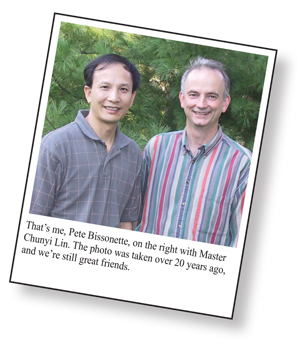
Dear Friend,
My name is Pete Bissonette. As a publisher of self-help programs, events, and books for four decades, I’ve sampled hundreds of alternative treatments, meditation, movement, hypnosis, and self-awareness techniques.
As a result, I’ve become a bit of a skeptic, because I’ve seen very few that actually make a lasting impact. You can be sure if my company offers a course or product, it’s had to pass the “Pete Test” of creating lasting results that can make a dramatic difference. In fact, the only person I know who is possibly more skeptical is my friend, award-winning reporter, and anchorman, Gary Rebstock. So, when I heard he’d met “an amazing man” while working on a news report, I was intrigued.
His name is Master Chunyi Lin. And he can show you how to eliminate the cause of sickness and its symptoms from your body!
While researching his story on Master Lin, Gary listened to one story after another about recoveries from cancer, fibromyalgia, arthritis, blood disorders, heart defects, migraines, allergies, weight problems, depression and practically anything else you can name – using a “mysterious” technique perfected by Master Lin called Spring Forest Qigong.
- Esther Trejo suffered from a rare lung disease. She was on oxygen 24-hours a day. Doctors said her only hope was a lung transplant. Using what she learned from Master Lin, she avoided surgery. She had been off of oxygen and free of medication for over 10 years when I met her. And she was not just healthier, she was happier too. “I am no longer a crabby S.O.B.!” she laughed.
- Jim Nance had a painful knot in his back. After one session, it completely disappeared.
- Sue Sivula had a bleed on her brain stem. She could turn her head, but her eyes wouldn’t move. Doctors wanted to operate. But she tried Master Lin’s method instead and was healed.
- Char Foss was the Director of Nursing at Anoka-Ramsey College. She took a class from Master Lin for teaching purposes. In the process, her back pain was eliminated.
- Gretchen Ventura suffered from migraine headaches. She had tried everything, but nothing helped. Then a friend told her about Master Lin’s technique. “It has virtually eliminated my headaches,” she said. “I am currently off all medications. I had been on daily medication for many, many years… fantastic!”
Just regular folks – with mind-blowing results!
Some of these people hadn’t even heard of alternative healing before. Many came reluctantly to see Master Lin, dragged by a caring friend or family member. Some had suffered for years with no relief. But they all came away with renewed health, hope, and happiness.
I call that a miracle. But my skeptical journalist friend called it a challenge!
As far as Gary Rebstock was concerned, the claims sounded too good to be true. Being a reporter, he looked for both sides of the story. He persisted with his interviews.
He met time after time with Master Lin. He pored through scientific research and met with medical doctors. And when all was said and done, his newscast was so glowingly positive, some people thought it was a commercial instead of a news story! But every word was true.
As I watched the report from Channel 9,
I saw for myself how Master Lin worked his “magic.”
It’s an ancient Chinese technique called Qigong (pronounced chee-gong). It works with your body’s energy, which is called “Qi” (pronounced “chee,” and sometimes spelled “chi”). Chinese medicine says:
- When your “Qi” energy isn’t flowing freely, you can get sick, stressed, or emotionally out of kilter. Disease, pain, health problems, and negative emotional conditions are symptoms of blocked energy. That’s why Master Lin says, “Sickness is nothing to fear.”
- Qigong is a way to gently and thoroughly release nearly all energy blocks and eliminate most causes of illness and imbalances. It’s extremely powerful – yet the practice of Qigong is surprisingly simple and easy to do.
As medical doctor and best-selling author Richard Gerber put it:
“…by moving Qi through the body, you can heal yourself of many ailments.”
And it’s been around for centuries. Qigong is actually the grandfather of Chinese medicine, including Tai-Chi, acupuncture, and Shiatsu. Some say it is the basis for Reiki and similar practices. But only in the past few decades has its medical nature become known to the rest of the world. In a PBS documentary, Dr. Wang Chong Xing from the Shanghai Institute of Hypertension said that after 30 years of study, “We think Qigong can cure every kind of disease, some responding better than others.”
And here’s the good news: Master Lin isn’t the only person who can do this.
Now you can learn how to do it, too
Until the last 20 to 30 years, you never would even have the chance to learn how to use it.
You see, in the past, Qigong was taught in secret, or made extremely complicated. Qigong Masters would only dole out small teachings at a time and required years of study from their students. This is how Master Lin had to learn Qigong. Year after year after year, under the guidance of some of China’s most revered masters, in the most remote regions of the country.
Through his years of study and practice, Master Lin discovered a startling and profound truth: “The most powerful is also the simplest.” And he realized that the most powerful aspects of Qigong could be contained within a few precise movements and meditations.
Inspired by his great love for mankind, Master Lin did what no Master at his level had ever done. He stripped away the mystique, confusion, and drama surrounding Qigong. And he distilled the practice down to a fast and easy-to-follow system called Spring Forest Qigong.
- Spring Forest Qigong is so powerful, a little goes a long way. Yet so pleasurable, you won’t want to stop.
- It’s so easy, you can do it whether you’re 5 or 105. (And if you start doing it now, you have a better chance of making it to the age of 105!)
- It’s so effortless, you can do it while standing, sitting, or lying down. You can even do it while you sleep. (I’m not kidding!)
- Most important, it doesn’t wear you out or make you sore like strenuous exercises. Spring Forest Qigong offers instant energy, immediate pain relief, and a sense of alert calmness. You feel good while you do it and great when you’re finished!
The morning I finally met Master Lin was the morning that changed my life. I attended a Spring Forest Qigong workshop led by Master Lin himself. He greeted us with a smile. When his eyes met mine, an actual physical sensation of calmness washed through me. I’d never felt anything like this before! Without wasting a minute of time, Master Lin began speaking, and right away told us some of the most important secrets about Qigong.
Then he asked, “Would you like to try it?” I couldn’t believe we could get started so soon! Could something this powerful really be so simple?
Master Lin was silent for a moment, then he said: “Before you begin, I will give you the password.”
He told us always to say the password in our minds whenever we practiced Spring Forest Qigong. Then he closed his eyes and began:
“I am in the universe. The universe is in my body. The universe and I combine together.”
Master Lin opened his eyes and explained how to use this password to wake up your inner wisdom, and open to the power of the universe. “Once you open to the universe, the energy will be with you.”
I felt like I was in Star Wars. Except this was for real! Master Lin showed us how to do a simple movement he called Breathing of the Universe. And I began to grasp just how powerful this could be.
It took no more than 4 minutes. It was relaxing but left me feeling deliriously energetic. I couldn’t wait to do it again! And so I began my regular practice of Spring Forest Qigong, doing at home what I learned from Master Lin.
It felt so good, it was practically addicting!
Soon I was inviting co-workers to join me each day at the office. Before long, we were all looking forward to our 11:30 a.m. sessions. We still do it every weekday here at Learning Strategies, and today we stream it free on the internet to our clients.
- Paul Scheele, our company co-founder, did Spring Forest Qigong to help his blood sugar and energy levels remain balanced throughout the day.
- Lynn Daniels was amazed when her horrible headache, body aches, and stomach cramps disappeared within 5-10 minutes.
- Kristi Wraspir’s digestive issues healed and she no longer experienced chronic anxiety – she felt more calm and balanced.
- Lynette Ayres got rid of the painful arthritis in her feet.
- Patrick O’Neil was surprised how quickly his own pounding headaches cleared. “Pete,” he told me, “The results are REAL! I actually felt the pain move out of my body!”
- I showed my skeptical sister, Jolette Gregorich, how to erase the tightness from her painful shoulder. Now she’s happy and free of pain and says, “Be sure to mention that THIS REALLY WORKS!”
- And I told my mom about it, too, back in the 1990s. She had lung disease and needed surgery. She began doing Spring Forest Qigong. When she had her operation, she was the ONLY patient out of SIXTY, sent home after just three days. The other patients all spent at least TEN nights in intensive care – IF they even survived. Mom’s doctor, Fernando Martinez, M.D., attributed mom’s rapid healing to her Qigong movements. Mom has since passed, but she did her practice nearly every day, because it always helped her feel good.
One weekend, I spent a few hours twisted in awkward positions doing electrical work on my house. The next day, I woke up stiff and sore. But I used Spring Forest Qigong for just THREE MINUTES and the pain and stiffness disappeared entirely.
The more I experienced and heard – the more I believed that the entire world needed to know about Spring Forest Qigong.
It didn’t take long for me to go to Master Lin and ask if he’d work with us to create a program people could use at home. He was delighted. “I want ALL people to know they have the ability to prevent illness and heal themselves,” he said.
We published the original Spring Forest Qigong course in 2000. It was an immediate and incredible success. Over these past two decades, more than 103,000 people have purchased the course and hundreds of thousands more have experienced it through our many special events.
Today, we at Learning Strategies are proud to bring you the new Spring Forest Qigong Five Elements Self-Healing Personal Learning Course, by Master Chunyi Lin who is now recognized worldwide as
Grand Master Chunyi Lin
The course was completely updated in 2022 with new healing movements and videos to make healing faster and even more complete. The course is presented through a unique video teaching methodology developed by Learning Strategies that Master Lin is absolutely thrilled with and calls “revolutionary!”
Your Spring Forest Qigong course will show you how you can help heal yourself from just about every type of physical and emotional ailment—using nothing more than your own natural energy. You’ll discover how to prevent blockages BEFORE they occur—and how to help clear toxic build-up every single day—so you can remain healthy and live a long and healthy life.
Through your practice of Spring Forest Qigong, you can discover:
- A tiny shift in your posture that can literally melt the pounds away. (See the difference on your bathroom scale!) See Deep Healing Using the Body video.
- How to use a simple sound to help you sleep better at night. See Sitting Meditations video.
- An easy movement that can clear a headache, cough, or stuffy nose in as little as five minutes. See Vital Elements of Qigong video.
- A simple way to give yourself a full-body energy massage in seconds. See the Manual.
- An easy movement that balances Qi and helps heal your reproductive organs. See The Healing Movements video.
- How to alleviate hip, knee, and joint pain and relieve sciatica by simply tapping your hips. See the Manual.
- An instant way to boost your passion and endurance. Forget Viagra! Master Lin says, “I regularly hear from couples who are enjoying a very active ‘second honeymoon’ – at ages of 60, 70, and beyond!” See Good, Better, & Best Practices video.
- Where and how to cup your arms to help clear congestion in your lungs and diminish coughing. See the Manual.
- Where to tap on your face to alleviate a headache. See Cultivating Qi video.
- A simple motion using your index and middle finger—that helps you ease pain in someone else’s body. It seems like magic, but it is not. See the Manual.
- A fun little game that PROVES the power of your “Qi” energy. Try this simple exercise to grow the length of your fingers—right before your very eyes! (Don’t worry, Master Lin shows you how to return them to their original size!) See Introduction video.
I’m sure you have questions.
Here are answers to the ones I hear most often...
Q. “How long will it take for me to learn Spring Forest Qigong?”
A. Literally NO TIME at all. Simply follow along with Master Lin in your Course videos and you’ll be doing it! There’s nothing complicated to memorize or figure out. In the past, Qigong took years of study and intensive practice. But Master Lin cut through the “drama” and complexity of Qigong. He distilled the practice down to its purest essence, consolidating the movements into bite-sized pieces in easy-to-follow videos that you can watch online or from DVDs.
Q. “Do I have to believe in this for it to work?”
A. No. Just as you don’t have to “believe” in water for it to quench your thirst, you don’t have to “believe” in Qi energy for it to be real. I’ve heard from countless very skeptical people through the decades who did the movements on the first video and saw immediate results. They saw headaches, arthritis, and joint pain disappear completely as well as reductions in swelling and inflammation, allergy symptoms, depression and mood swings, and sleeplessness.
Q. “Are these movements in the Course taught by Master Lin in his personal workshops?”
A. Yes, they are. In fact, you’ll probably feel like Master Lin is right there with you! Teachings from his private sessions are included in the Course.
Q. “Should I practice Spring Forest Qigong even if I’m healthy?”
A. The best time to stop blockages is BEFORE they occur. Practicing Spring Forest Qigong Five Elements Self-Healing keeps your energy flowing to prevent sickness in the future. It enables you to slow down the aging process, maintain a more youthful and energetic body and mind, and enjoy increased happiness and enjoyment of your life. That’s why I practice it as well as many of the people who work with me at Learning Strategies.
Q. “Can I do this even if I have physical challenges?”
A. Definitely. You can do Spring Forest Qigong standing, sitting, or lying down. And you don’t have to do all the movements. You can get results even if you just do a little, to the best of your ability. Spring Forest Qigong can improve your quality of life and reduce pain, no matter what condition you are in. Of course, you should always consult with your physician or other licensed health care practitioner before changing or discontinuing any current treatment. Qigong should be used as a complementary practice for medical care—not as a replacement.
And by the way, people who do Qigong while having chemotherapy report less nausea and faster regrowth of their hair. And people who undergo surgery have less pain and heal faster. Injuries, wounds, sprains, and fractures also heal faster.
Q. “How often should I practice Spring Forest Qigong?”
A. Once a day for five minutes is good. Three times a week for thirty minutes is better. 30 minutes a day for two to three months is best. If you don’t have this much time, do whatever you can do. You can even do it while waiting in traffic, taking a walk in the park, sitting at a concert, waiting at a bus stop, and even while sleeping!
Q. “How do you know it will work for me?”
A. That’s a question only you can answer. That’s why we offer a 30-day trial period. I want you to prove to yourself that this course contains everything I say it does.
Everyone’s experience with Spring Forest Qigong is different. You may or may not experience what others have. Master Lin says some people’s problems might be too severe, after all, we do not live forever.
The BEST way to learn more about Spring Forest Qigong Five Elements Self-Healing is to do it! You’ve read what others have experienced. You know how I feel about it. But you have to experience it for yourself to believe it.
There are two ways to learn Spring Forest Qigong with Five Elements Self-Healing
You can get the Main Course to learn and practice the basics. Or you can go further and get the Deluxe Course to supercharge your healing. Here is what you get with the Main Course:
Spring Forest Qigong Video Training
Follow along as Master Lin beautifully demonstrates each healing movement for you on Video A. Effortlessly and quickly, you’ll see how to use your energy to heal yourself.
After a few practice sessions with Video A, watch Video B. This time as you practice along with Master Lin, he’ll explain how to use five powerful emotions to heal even quicker. These emotions are Happiness, Joy, Peace, Contentment, and Gratitude and each, remarkably so, helps to heal different organs in the body. As you do the healing movements, you’ll feel those emotions. You might have a breakthrough healing right then and there.
Then in your next session practice along with Video C, which is called the Miracle of Qi. Master Lin will tell you his amazing story of healing.
In Video D you’ll learn about the three principles of Qigong that help you go more deeply into the place of infinite intelligence, where you connect with the flow of pure Qi energy.
When you practice along with Video E, you’ll learn about the harm unbalanced emotions can cause plus how to use Nutrition, the Weather, and Feng Shui to heal yourself.
Master Lin will explain the Keys to Success in Video F. And his teachings will continue as you practice along with him. What an amazing way to learn about healing yourself!
In all, you will receive 10 video practice and learning sessions! Plus, you’ll receive three practice sessions without hearing Master Lin’s teachings. Sometimes you’ll just want to do the movements with a quiet mind.
Three Healing Meditations
You will receive three meditations, Five Positive Emotions, Small Universe, and Deep Healing.
All you have to do is sit down, push play, close your eyes, and follow along. Master Lin will guide you to use your mind to quicken your healing. You will love the way you feel after you do any of these Healing Meditations.
Audio Sessions to practice by
For those times you don’t want to watch the videos, you will receive two audio-only recordings to guide your practice. They are the same as the practice-only video sessions, providing minimal guidance. You can even use these recordings to practice outside in your garden, or in the woods, or on the shores of a beautiful lake.
Exclusive Manual
The manual leads you step-by-step through your practice of the Spring Forest Qigong healing movements. Master Lin carefully describes and demonstrates every movement and meditation and includes all the tips, insights, and directions you need to achieve the powerful benefits of Qigong.
Plus, a free gift ($20 value!) when you enroll...
The Inner Beauty meditation music, inspired by Master Lin during a morning meditation, is breathtaking music ideal for Qigong, meditation, yoga, massage, or just relaxing at home. And it’s yours to keep at no cost – even if you decide not to continue with your Spring Forest Qigong practice.
Upgrade and receive “Deep Healing” techniques to improve your health and well-being. Healing has never been easier.
Now, let’s explore the Deluxe Course to supercharge your deep healing so that you can heal faster and more completely… so you can raise your vibration… so you are happier and filled with joy… and so you can live full of abundance and vitality.
“Energy Systems” of the Body
There are five main energy systems of the body for Qigong healing.
Each system involves multiple parts of your body. The Heart System, for example, includes the tongue and small intestines. Because of this, a problem in one organ indicates the possibility of a problem in another organ. If a person has problems in the small intestines, you are likely to find a blockage in the heart.
Each system is also associated with emotions. Grief, sadness, crying, and depression can weaken and harm the Lung System. So, if a person suffers from depression, you are likely to find blockages in the various organs of the Lung System.
This is briefly described in the Main Course, and you go deeper in your understanding and ability to heal with the Deluxe upgrade. It’s a good thing.
You will receive 8 additional videos sessions to take your exploration of energy and healing deeper
In your Main Course, you’ll receive 10 video practice and learning sessions. Each is 30 minutes. Simply play the video and do the movements along with Master Lin. While you practice (and while you heal), Master Lin will teach you about so many aspects of Spring Forest Qigong to make the experience richer, pleasurable, and satisfying.
In your Deluxe Course you will receive 8 more practice/learning videos. As you practice along with Master Lin, you’ll learn even more exciting and powerful ways to live a life of perfect health and well-being. Here is a brief description of each.
Deep Healing through Breathing
The three most important aspects of healing with Spring Forest Qigong Five Elements Self-Healing are controlled breathing, focused concentration, and simple movement. In this session Master Lin will help you make simple adjustments in your breathing to have an immediate and powerful effect on your health.
Deep Healing through the Mind
Your mind is incredibly powerful for healing. Master Lin will help you to harness and guide it for good.
He will also help your find your Life Purpose, know your Life Passion, and combine your mind and heart for perfect healing.
Deep Healing using Your Body
One of the reasons people get sick is because the “yin and yang” energies scatter. In this session Master Lin will teach you a trick using your knees to immediately bring those energies in balance. It can even help you lose weight. Yay!
Deep Healing through the Heart
When you learn how to “open your heart” it can help you in every part of your life including quick advancements in your career, more satisfying relationships, significant improvement in your personal performance, and your own spiritual enlightenment.
Deep Healing with Love
By understanding the three levels of love—conditional love, unconditional love, and universal unconditional love—you will learn how to use love to heal physical challenges, mend a broken heart, and guide your daily life.
Deep Healing through Forgiveness
What you may not know is forgiveness can be the quickest way to self-healing. That’s right! Blockages can disappear by simply saying “I forgive you” or by feeling forgiveness in your heart. That’s why the tenets of Spring Forest Qigong have always been Love, Kindness, and Forgiveness.
Deep Healing in the Present Moment
During this session Master Lin will help you find joy in every moment so it is easier to stay present and engaged in your practice as well as your life, and you will learn how to focus on the feelings of the positive Qi energy instead of the negative feelings of symptoms. (You’ll quit thinking about pain!)
Deep Healing through Generational Energy
You may not know this. You may not even have a way to fathom this. But there is great healing wisdom in the energy of your ancestors going back generation after generation.
If you can tap into “generational energy,” you can heal so quickly and thoroughly, you might not even be able to remember what it was like to have pain and suffering.
Even more ways to do the Healing Movements of Spring Forest Qigong
As I mentioned before, you will be receiving many videos where Master Lin shares his expertise during your practice session.
There will be times that you want to practice with his teachings. Sometimes you’ll simply want pleasant music in the background, nature sounds, or even silence.
When you order the Deluxe Course, you will receive a total of 9 practice-only sessions. They contain only minimal guidance from Master Lin. Use your favorite or use them all in rotation!
Additional Magnificently Beautiful Meditations
Meditation is an important part of Spring Forest Qigong. Master Lin says you need both simple physical movement AND meditation. It’s about using your body AND your mind.
In the Main Course you will receive four meditations: 1) Five Positive Emotions, 2) Small Universe, 3) Small Universe with minimal guidance, and 4) Deep Healing. They are all you need. But in the Deluxe Course we give you ten more options.
These ten special meditation options will only be available through your online digital Library. The Library is easy to use, and you’ll have permanent access.
Hundreds of thousands of people have joined before you, and now it is your turn
The miraculous results people have seen from their practice of Spring Forest Qigong have inspired me.
- One person told me in the past 12 years she had not slept for more than a couple of hours at a time because of intense, pervasive pain. After she followed the video one time, she slept through the entire night.
- Another woman called with lymphoma. She barely had the energy to order the course, and when she began practicing, she could only stand to move two or three minutes a day. Two months later she telephoned me—after 30 minutes on the treadmill.
- One woman called from the hospital after the MRI showed her to be cancer-free. She had been practicing Qigong with a friend for two months.
You’ll love the way you feel when you try it. And we can’t wait to hear about how your life transforms.
Experience your own personal
training with one of the world’s
most accomplished and gifted
Qigong Grand Masters
You get everything you need in this simple, uncomplicated program. Right there in your own home, available for you no matter what health or emotional challenges come your way over the years.
The Main Course consists of an Introductory video learning session, 10 video practice/learning sessions, five practice-only sessions with beautiful music or nature sounds (3 video, 2 audio), three healing meditations, the extensive manual, and the free meditation music gift, Inner Beauty ($20 value).
In the Deluxe Course, you get everything in the Main Course plus you also get eight more video practice/learning sessions designed for Deep Healing, six variations of a practice-only video with music or nature sounds, ten healing meditation options in your digital Library, and the soothing Back Into the Universe music as a free gift ($20 value).
Your Deluxe Course gives you further training and more ways to use the Qi energy to heal. You will learn how to use Breathing, the Mind, the Body, the Heart, Love, Forgiveness, the Present Moment, and Generational Energy to heal more completely, with greater balance and more harmony.
With the Deluxe you also receive a bonus of two Paraliminal audio sessions designed to activate your subconscious mind. (If you haven’t heard about Paraliminals before, look for the special Paraliminal insert in this envelope. Millions of Paraliminals have already been used by people all over the world.)
Another great bonus with the Deluxe course are tips for easier and more thorough healing from Master Lin’s Healing Connection. For ten years now, Master Lin has met live nearly every week with Spring Forest Qigong practitioners. You will receive recordings of our four favorite sessions!
Think about what you’ve paid for in workshops over the years. Or how about all the gadgets and potions, trying to stay healthy or help an illness. You’ve probably spent a lot of time and money on books and supplements and doctor’s appointments that promised to make you feel better – but never really did. We’ve all done it.
For a fraction of all that you can have the Spring Forest Qigong Five Elements Self-Healing course. And, there’s nothing else you need. No equipment or special clothes. Nowhere to drive to. It’s all yours, right there at home.
When you order we will ship the DVD/CD version to your home plus you will receive the online digital version. (Or, if you prefer, you can choose to receive just digital. If you choose just digital, we will send you the printed manual at no additional charge.)
THIS PRACTICE REALLY WORKS. And your satisfaction is guaranteed. So, if you’re not satisfied, you won’t be stuck with another course “gathering dust.”
What’s more, practicing Spring Forest Qigong can SAVE YOU MONEY. It’s expensive to get sick, even when you have insurance. I know people with such bad migraines, they could not go to work. Now their headaches are under control. The cost of missing work, prescription medications, hospital bills—it’s significant.
Your Satisfaction Guarantee
You will not need weeks to know whether this course is of value to you—you will know right away. Qigong healing is that effective.
You will still receive a 30-day money-back satisfaction guarantee. Plus, if you need help, we are here to serve you with online groups/forums, and you can also email our office for coaching.
As I said earlier, I’ve been practicing Spring Forest Qigong with Master Lin since 1996. We published his first course in January 2000. Over 10,000 people purchased the course in the first two years. Wow! The course you’re reading about today is a complete remake taking into consideration advancements Master Lin has made in the practice over the years and what we’ve learned to make it more enjoyable, pleasurable, and effective.
Naturally, you have to be smart about your health and well-being and do what’s right for you
Only you can know if Spring Forest Qigong is the answer for you.
Try it and then decide for yourself.
You have absolutely nothing to lose. And a lifetime of health and happiness to gain!
Best wishes,
Pete Bissonette,
Publisher
P.S. Oh, and by the way, guess what happened to my reporter friend, Gary Rebstock?! The news report on Master Chunyi Lin and Spring Forest Qigong changed Gary’s life—forever! Not just professionally, but personally as well. With 30 years in the TV news business as a reporter, anchor, and producer, he’d never done or seen a story that received such an overwhelming response or made such a profound difference in people’s lives. A few years later, Gary gave up his TV news career to work with Master Lin to share this amazing gift with the world. (He has since retired.)
P.P.S. If you have any questions that I haven’t answered, please call or email! Our contact info is below. Ready to enroll and start your self-healing right now? You can easily order with the order bars below or call toll-free 1-866-292-1861 in the US and Canada (or 1-952-767-9800 from everywhere else). Take up to a full month to try the course at home and see for yourself. This just may be the answer you’ve been searching for!
Deluxe Course for deep healing so that you can heal faster and more completely
Spring Forest Qigong Five Elements Self-Healing Deluxe Course (DVD/CD)
$600.00
Spring Forest Qigong Five Elements Self-Healing Deluxe Course (Digital)
$600.00
Spring Forest Qigong Five Elements Self-Healing Deluxe Course (DVD/CD and Digital)
$660.00
Main Course to learn and practice the basics
Spring Forest Qigong Five Elements Self-Healing Main Course (DVD/CD)
$300.00
Spring Forest Qigong Five Elements Self-Healing Main Course (Digital)
$300.00
Spring Forest Qigong Five Elements Self-Healing Main Course (DVD/CD and Digital)
$330.00